If you have been living with chronic back pain, there is a good chance you have already tried more than one way to find relief.
Maybe you have gone to a chiropractor, worked through physical therapy, tried yoga or acupuncture, taken pain medication, or even considered injections or surgery.
Some of those options may have helped for a day, a week, or even longer.
But then the stiffness returned. The familiar ache came back. And once again, you found yourself planning your day around what your back might allow you to do.
That cycle can be exhausting, especially when every new solution gives you another reason to hope.
So why does chronic back pain relief sometimes seem temporary?
And could a different starting point offer a better way forward?
Why Chronic Back Pain Relief May Not Last
Many conventional back pain solutions focus on the place that hurts.
Stretch what feels tight. Strengthen what feels weak. Calm the painful area.
Those approaches can be useful. But they may not address the movement habits underneath the pain.
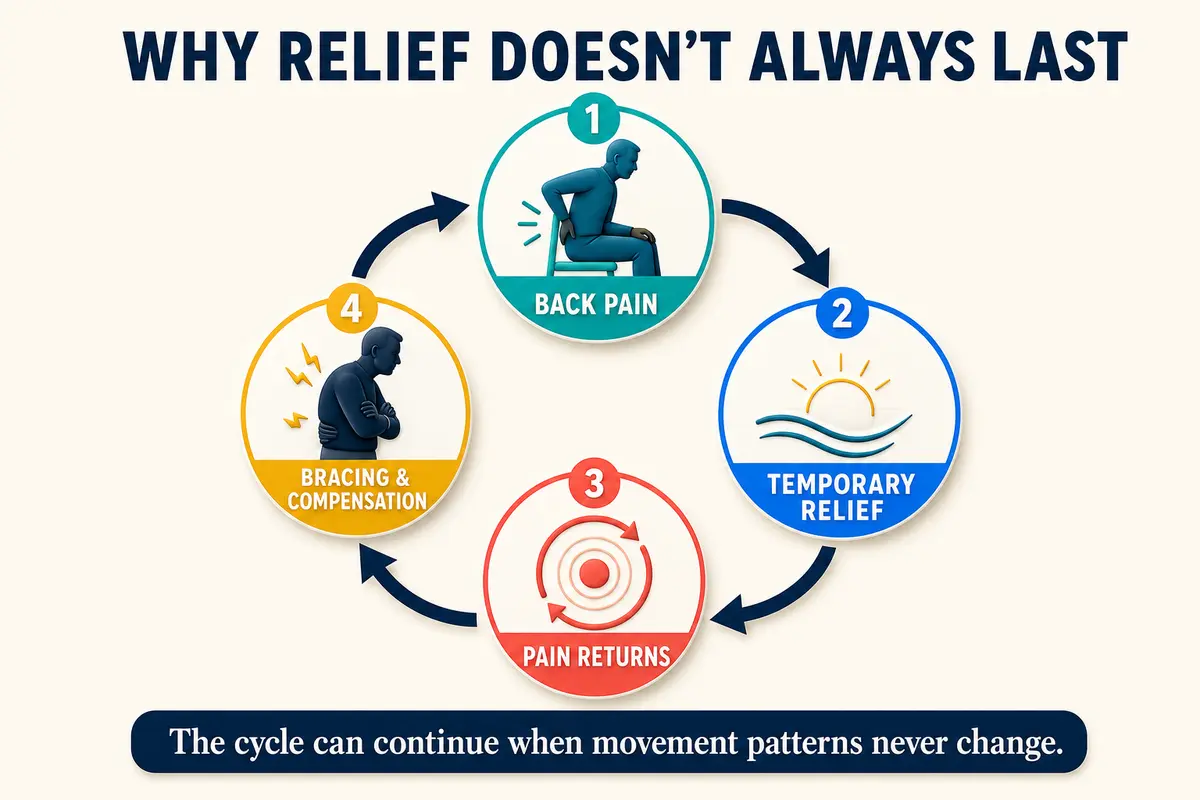
Over time, sitting, guarding, bracing, and compensating can change the way your body moves. The deep muscles designed to help support the spine may stop coordinating as efficiently as they once did.
When that happens, larger surface muscles often take over. They work harder, the body becomes more guarded, and ordinary movements can begin to feel stiff, unstable, or painful.
This may help explain why a treatment can quiet the symptoms without changing the pattern that keeps bringing them back.
It also explains why some traditional “core strengthening” routines can feel too aggressive. If the body has not first relearned how to engage its deeper support system, adding more effort may reinforce the same compensation patterns.
The missing step may not be more stretching or harder exercise.
It may be teaching the right muscles to work together again.
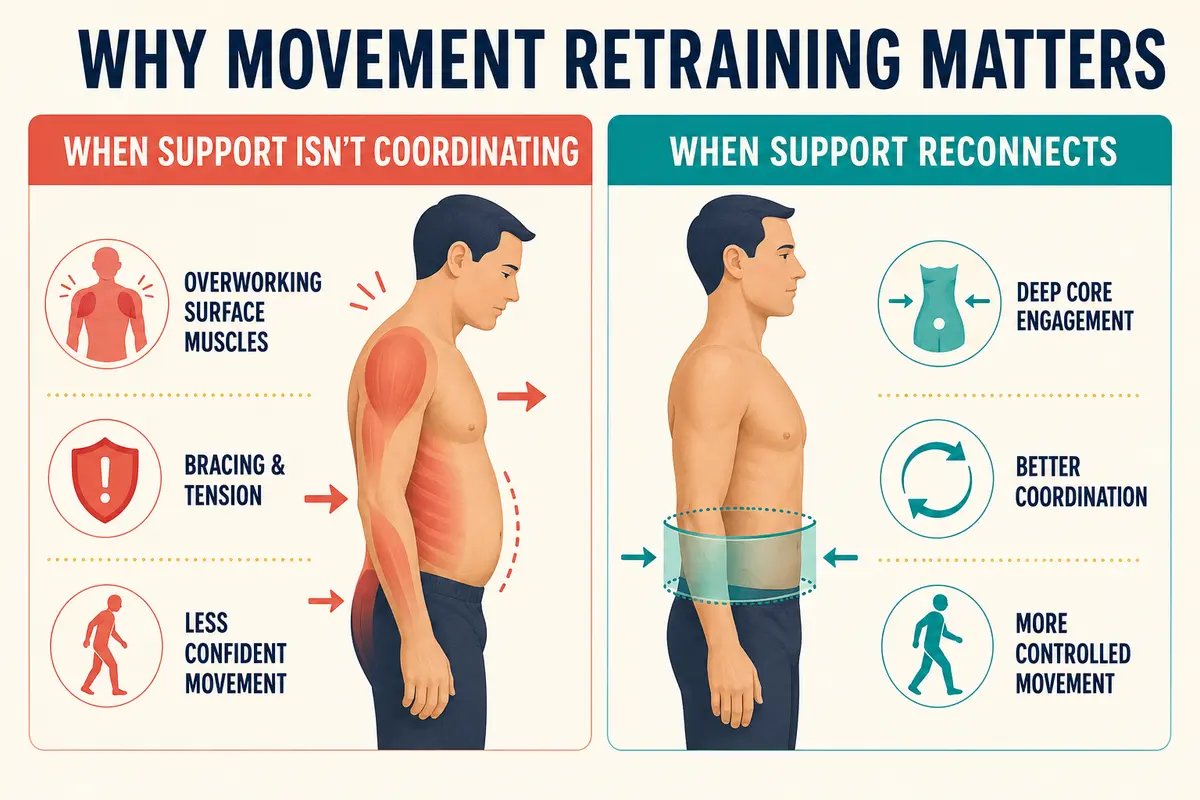
That is the idea behind movement retraining.
Instead of chasing pain from one area of the body to another, movement retraining looks at how the body prepares for and performs everyday actions.
It was also the discovery that changed the direction of Dr. Ryan Peebles’ life.
The Back Pain Struggle That Led Dr. Ryan Peebles to a Different Answer
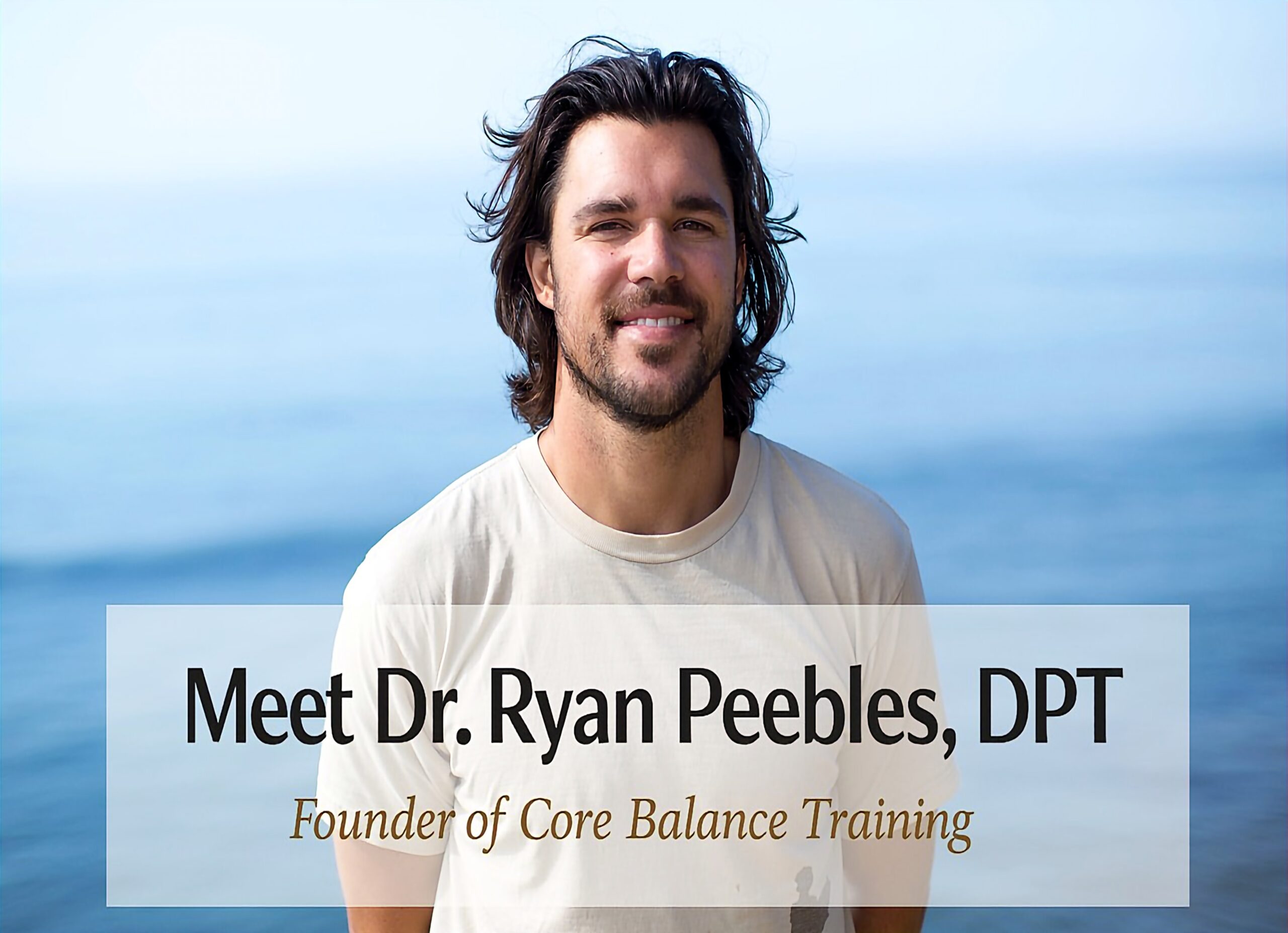
Long before he became a Doctor of Physical Therapy, Ryan Peebles was a Southern California surfer and athlete who lived for movement.
Then his own body began working against him.
As a teenager, shooting lower-back pain forced him to give up basketball and surfing.
Over the next decade, he tried nearly everything he could find, including chiropractic care, physical therapy, acupuncture, yoga, Pilates, inversion therapy, Rolfing, and Chinese medicine.
Some treatments brought brief relief. Nothing lasted.
One chiropractor told him he could be in a wheelchair by the age of 30. Another suggested he hold on and hope surgical technology improved.
By 24, Ryan had reached his lowest point.
Curled on the floor of his bedroom with pain radiating through his body, he realized he had two choices.
He could accept a future controlled by pain, or he could begin looking for an answer himself.
He chose the second.
Ryan began studying anatomy, biomechanics, and neuroscience as if his future depended on it.
Because to him, it did.
He read textbooks, research papers, and case studies. He paid close attention to his own movements and started noticing small patterns that had been overlooked.
Certain muscles were not doing their share of the work. Other muscles and joints were working overtime. Even the way he breathed and braced affected how stable his body felt.
The more he learned, the more he began to see pain differently.
Pain was not simply an enemy to silence. It was information that something in the body’s support and movement system was no longer working as it should.
Ryan went on to earn his Doctorate in Physical Therapy with High Honors in 2015.
While working with patients ranging from weekend athletes to elite competitors, he kept seeing the same problem.
People were treating pain, but they were not always retraining the movements connected to it.
That realization eventually became the foundation of Core Balance Training. You can read the full story of how Dr. Ryan developed his non-surgical approach to chronic back pain.
What Is Core Balance Training?
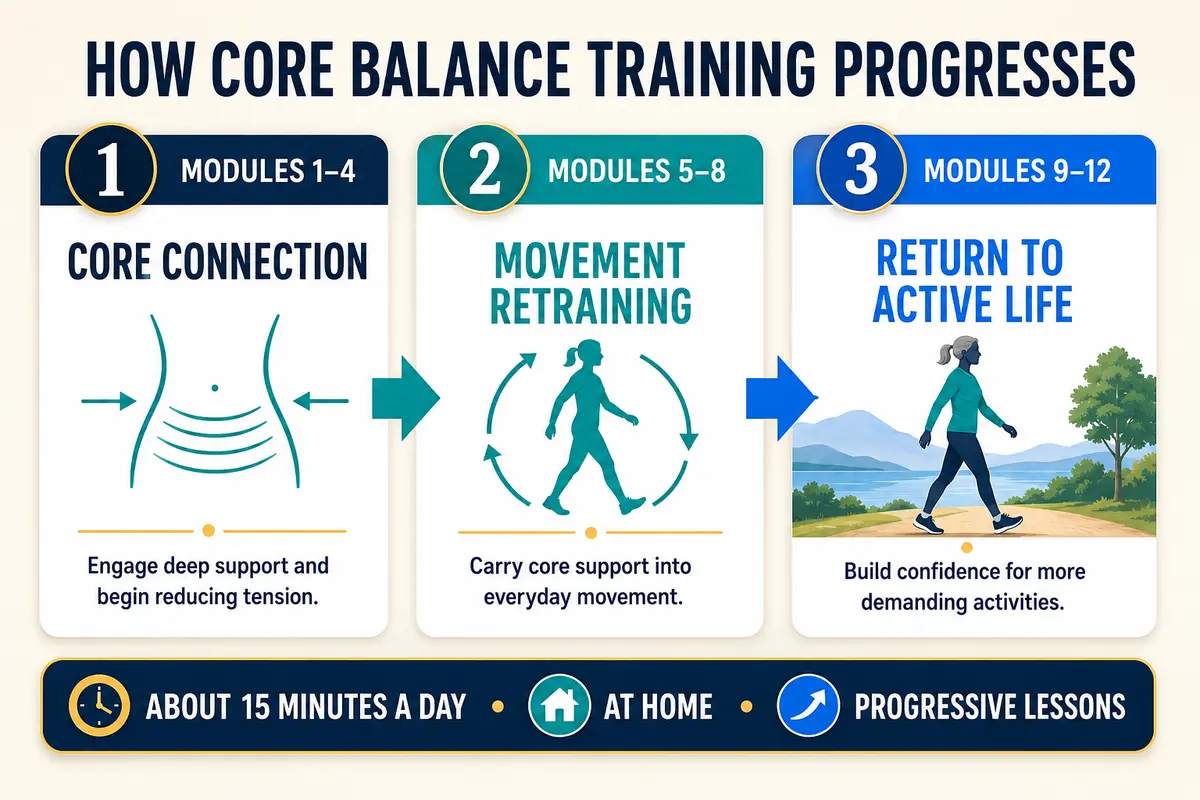
Core Balance Training is a 12-module, at-home movement program created by Dr. Ryan Peebles.
It is designed to help participants reconnect their deep core muscles, improve the way their body stabilizes the spine, and gradually carry those improved movement patterns into daily life.
Each guided lesson takes about 15 minutes.
The movements are gentle and progressive. No gym membership or complicated equipment is required.
Most importantly, Core Balance Training is not built around pushing through pain or exhausting the body with another intense workout.
It starts by helping you notice how you currently move. Then it teaches you how to create support before movement begins.
Over time, the lessons build strength and control on top of that foundation.
This is why the program is often described as movement retraining rather than ordinary core exercise.
How Does Core Balance Training Work?
The program follows a gradual four-phase process:
- Awareness. You begin by noticing how you breathe, brace, stand, and move. This helps reveal habits and compensation patterns you may not realize you have developed.
- Anchor. Next, you learn how to reconnect the deep stabilizing muscles that support the spine and pelvis before movement begins.
- Load. Once that connection becomes more familiar, the program introduces gentle resistance and controlled movement to help rebuild useful strength.
- Life Moves. Finally, you practice carrying these new patterns into the movements that matter outside the lesson, including standing, walking, bending, lifting, and returning to activities you enjoy.
Each lesson builds on what came before it.
You are not asked to jump into advanced exercises or force your body through movements it is not ready to perform.
The goal is to help your body develop a more stable and coordinated way to move, one manageable step at a time.
Try the First Lessons Free
See How Core Balance Training Works for Yourself
Get seven days of access and experience the gentle, step-by-step approach from the comfort of home.
- About 15 minutes a day
- Guided lessons at home
- Gentle, progressive movements
Cancel during the trial according to the current offer terms. Individual results vary.
What Does a 15-Minute Core Balance Training Session Look Like?
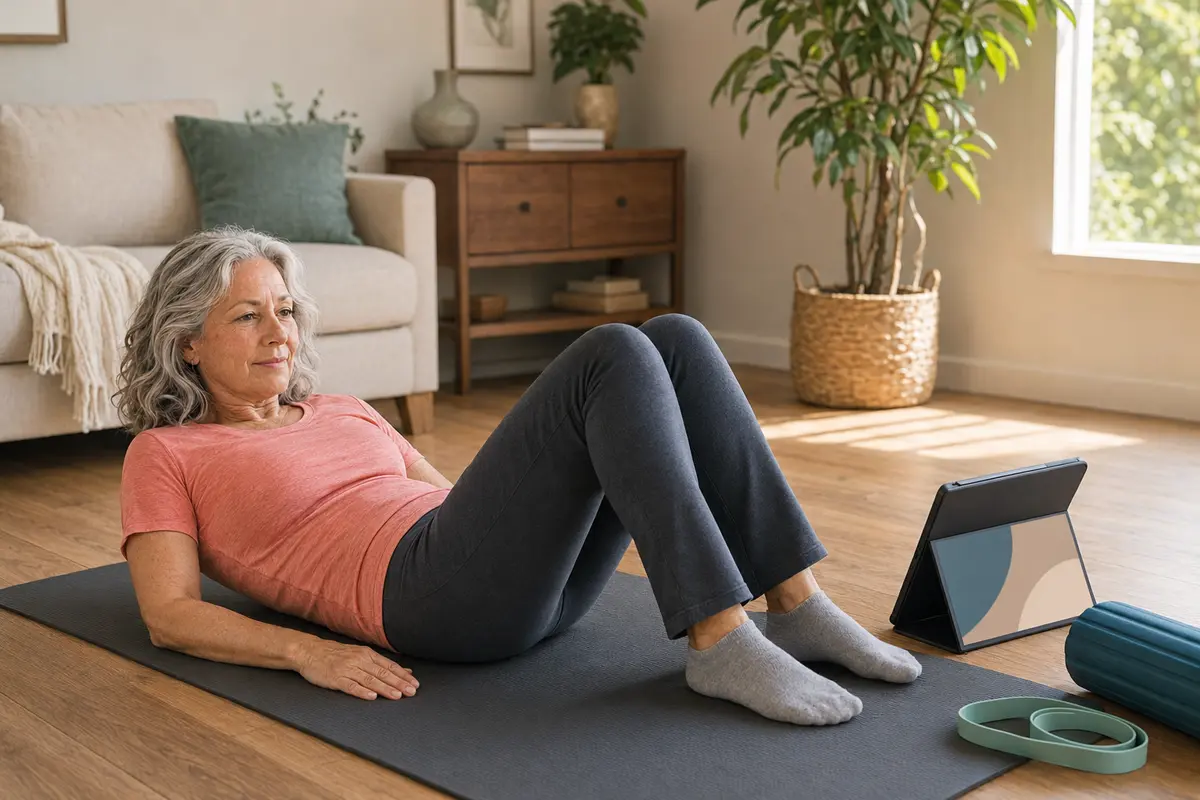
A typical Core Balance Training session is much different from a fast-paced workout video.
You follow Dr. Ryan through a short guided lesson at home.
The early sessions focus on awareness, breathing, and learning to feel the muscles involved in creating support.
The movements are controlled. The instruction is clear. And the pace gives you time to understand what your body is doing instead of rushing to complete a set number of repetitions.
As you progress, each module adds another layer.
You begin with connection. Then you add movement. Then you build strength and learn how to use that new control in daily life.
For days when discomfort starts to return, the program also includes a short Baseline Reset Protocol designed to help participants revisit the foundational movements.
The daily commitment is about 15 minutes.
That makes it easier to stay consistent, even if long workouts, travel to appointments, or complicated routines have been difficult to maintain.
Who Is Core Balance Training Designed For?
Core Balance Training may appeal to adults who:
- Have been dealing with recurring or chronic back discomfort
- Feel stiff, guarded, or unsteady during everyday movement
- Have tried other approaches but found the relief did not last
- Want a gentle program they can follow at home
- Prefer short, guided sessions over long workouts
- Want to improve strength and movement without starting with aggressive exercise
The program is used by adults with a wide range of ages and activity levels.
However, it is not the right answer for every condition or every person.
Anyone with severe pain, a new injury, worsening symptoms, numbness, weakness, or other concerning symptoms should speak with a qualified healthcare professional.
You should also consult your healthcare provider before beginning a new exercise program, especially if you have an existing diagnosis or have recently had surgery.
Is Core Balance Training a Non-Surgical Back Pain Solution?
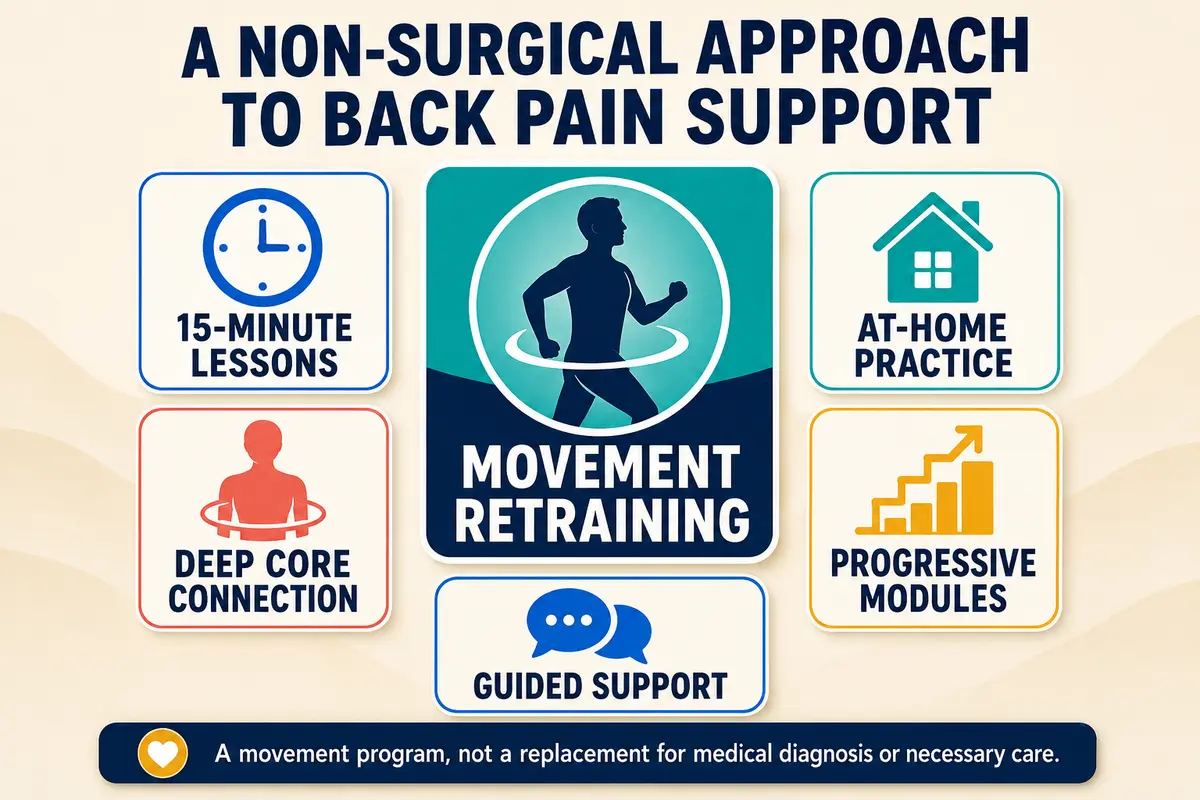
Core Balance Training is a non-invasive movement education and exercise program.
It does not involve medication, injections, or surgery.
For adults searching for non-surgical back pain solutions, its appeal is that the lessons focus on improving movement and internal support through gentle practice at home.
But non-surgical does not mean “a replacement for all medical care.”
Some back conditions require diagnosis, treatment, or surgery. Core Balance Training does not diagnose medical conditions, and no exercise program should be used to delay necessary care.
Its purpose is to help participants improve the way they stabilize and move their bodies.
For the right person, that may be an important part of a broader plan for moving with more strength, balance, and confidence.
What Core Balance Training Participants Say
If you have lived with chronic pain for years, skepticism is reasonable.
You have probably heard big promises before.
That is why the experiences of people who have actually completed the program matter.
Retired nurse Gloria Streett reported that her back and SI joint were no longer hurting and said even her doctor was impressed.
Cherie Baker, a retired physical therapy assistant, came to the program after three decades of constant pain and fear that she might eventually end up on disability.
Surfer and climber Rohan de Launey said the early phases changed his life and helped him return to surfing, climbing, and hiking.
Michele Gladieux, a physical therapist from Oregon, described feeling stronger in the right ways and hopeful again following an L5 disc injury.
Nick Balzano discovered Core Balance Training while preparing for spine surgery. After beginning the program and discussing his progress with his medical providers, he ultimately decided not to proceed with the scheduled operation.
These experiences do not guarantee that every person will have the same result.
They do show why the program has attracted tens of thousands of participants looking for another way to approach chronic back pain relief. You can also explore seven reasons people recommend Core Balance Training.

The Real Goal Is Not Simply Less Pain
Relief matters.
But for most people, the deeper goal is getting their life back.
It is walking through an airport without worrying about every step.
Getting down on the floor with a grandchild and knowing you can get back up.
Gardening, golfing, traveling, dancing, or simply making dinner without needing to stop because your back has taken control of the evening.
Those ordinary moments become much more meaningful when pain has kept them out of reach.
Dr. Ryan’s own journey reflects that possibility.
Years after being warned about a future in a wheelchair, he returned to surfing, climbing, and the active life he once feared he had lost.
His story does not mean every person will follow the same path.
But it offers an important reminder.
Your current limitations do not automatically have to define your future.
Just 15 Minutes a Day
What Could Moving With More Confidence Change for You?
Try Core Balance Training free for seven days and discover whether this gentle movement-retraining approach feels right for your body.
- Seven days free
- 12 progressive modules
- Guided at-home access
See the Program and Start Free →
No pills. No shots. No surgery. Consult your healthcare provider before beginning.
Questions Answered
Frequently Asked Questions About Core Balance Training
What to know before deciding whether the program is right for you.
How long does Core Balance Training take each day?
Most guided sessions take about 15 minutes. The lessons are designed to be short enough to complete consistently at home without turning the program into another overwhelming commitment.
Do I need exercise equipment?
The program is designed to be completed at home without a gym or complicated equipment. Follow the instructions provided with each lesson so you know what, if anything, is recommended as you progress.
Is Core Balance Training a workout program?
Not in the traditional sense. Core Balance Training focuses first on awareness, deep-core connection, stability, and movement coordination. Strength is added progressively after the foundational patterns have been established.
Is Core Balance Training only for lower back pain?
Many participants begin because of lower back discomfort, but the program looks at how the core, spine, pelvis, breathing, and everyday movements work together. It is not intended to diagnose or treat any specific medical condition.
Can adults over 50 use Core Balance Training?
The gentle, progressive structure may make the program approachable for many adults over 50. Age alone does not determine whether a movement program is appropriate, so speak with your healthcare provider if you have concerns about your health, mobility, or an existing condition.
Can I use Core Balance Training if I have a herniated disc, sciatica, or spinal stenosis?
Those terms can describe very different situations and levels of severity. Core Balance Training cannot determine whether exercise is safe for your specific condition. Ask a qualified healthcare professional who understands your medical history before starting.
Is Core Balance Training a replacement for physical therapy or medical care?
No. It is an educational movement and exercise program. It should not replace an examination, diagnosis, physical therapy, or any treatment your healthcare provider believes is medically necessary.
What happens during the seven-day free trial?
The free trial gives you access to the beginning of the program so you can experience Dr. Ryan’s teaching style and foundational approach for yourself. Review the current offer terms on the official program page before enrolling.
What if Core Balance Training is not right for me?
You can cancel during the trial according to the program’s current terms. Paid options are also covered by the guarantee described on the official program page. Always review the latest pricing, cancellation, and guarantee details before purchasing.
How quickly should I expect results?
There is no universal timeline. Some participants report noticing changes early, while others require more time and practice. Your condition, consistency, movement history, and overall health can all affect your experience. Individual results vary.
You May Not Need a Harder Workout. You May Need a Better Starting Point.
If you have tried to stretch more, strengthen more, or simply push through the pain, the idea of starting more gently may feel almost too simple.
But the first goal of Core Balance Training is not to prove how hard you can work.
It is to help your body feel and use its own support system again.
Then, one short lesson at a time, you build from that foundation.
You can try the beginning of the program free for seven days and decide for yourself whether the approach makes sense for your body.
No pressure. No need to make another enormous promise to yourself.
Just a chance to take a different first step.
If you are still comparing your options, see our report on the leading online programs for chronic back pain relief.
You Are Not Out of Options
Start With One Gentle 15-Minute Lesson
Explore Core Balance Training free for seven days and see what can change when your body learns a more supported way to move.
- Seven days free
- About 15 minutes a day
- Cancel during the trial
Cancel during the trial according to the current offer terms. Individual results vary.